Maho beauty

Maho beauty
“Come, butterfly It's late- We've miles to go together.” ― Matsuo Bashō, On Love and Barley: Haiku of Basho
Rodomi pranešimai su žymėmis origami. Rodyti visus pranešimus

2015 m. gegužės 10 d., sekmadienis

Folding life: ART OF ORIGAMI 

Origami paper is used in the traditional Japanese art of paper folding. In fact, the word itself is made up of two words, “ori” which means fold and “kami” meaning paper. We have a wide selection of origami paper at Maho beauty shop in range of exquisitely patterned, colourful or more simple designs. Available here: http://www.mahobeauty.com/index.php…

友禅 Japanese Yuzen Origami Folding Paper 24 pattern set. Available here: http://www.mahobeauty.com/index.php?route=product%2Fproduct&path=59_71&product_id=341

Paper was first said to have been introduced into Japan by Buddhist monks around the 6th century. During this time the cost of paper was very expensive and was more a novelty to have than part of an everyday hobby. It was therefore only the wealthiest Samurai and Noblemen who had the unique opportunity to enjoy origami and often used the folded paper to accompany gifts.
Japanese Origami Folding Paper 20 pattern set. Available her: http://www.mahobeauty.com/index.php?route=product%2Fproduct&path=59_71&product_id=346

These days, while some people consider it a real art form that is very Zen-like in its simplicity and depth, origami is regarded mainly as an activity for children, who are taught just a few standard designs. Even in Japan, the most complicated design that most people master is the 
tsuru (crane), which has developed into a worldwide symbol of children's desire for peace. But origami has a long history and was originally not for children at all. 
Beautiful two-sided handmade Japanese Yuzen Chiyogami paper with traditional patterns.
http://www.mahobeauty.com/index.php?route=product%2Fproduct&path=59_71&product_id=342
Like many things in Japanese culture, origami (from "oru" meaning to fold, and "kami" meaning paper) has its origins in China. It is believed that paper was first made, and folded, in China in the first or second century. The earliest records of origami in Japan date to the Heian Period (794-1185). It was during this period that Japan's nobility had its golden age and it was a time of great artistic and cultural advances. Paper was still a rare enough comodity that origami was a pastime for the elite. Paper was folded into set shapes for ceremonial occasions such as weddings. Serrated strips of white paper were used to mark sacred objects, a custom which can still be seen in every shrine to this day.

JAPANESE TOYO CHIYOGAMI DZUKUSHI ORIGAMI PAPER. 45 DESIGNS Available here: http://www.mahobeauty.com/index.php?route=product%2Fproduct&path=59_71&product_id=34

It was in the Edo Period (1600-1868) that much of today's popular traditional culture developed as forms of entertainment for the merchant classes and the common people. Kabuki and ukiyo-e are just two examples and origami also gained poularity. By the mid-19th century, 70 or more different designs had been created. But aside from its ceremonial use, its popularity has been in decline since the Meiji Period(1886-1912) and the modernization of Japan.In the mid-1950s, 11-year old Sasaki Sadako developed leukemia as a result of her exposure to radiation as a baby during the atomic bombing of Hiroshima in 1945. Tradition held that if you made a senbazuru (a thousand paper cranes) and made a wish after completing each one, your wish would come true. Sadako set about making the tsuru, wishing for her own recovery. As she continued, she began to wish instead for world peace. One version of the story says that she died when she had made only 644 and her school friends completed the full number and dedicated them to her at her funeral. A perhaps more reliable version says she completed the 1,000 and went on the fold several hundred more before succumbing to the cancer at the age of 12. 


Regardless of the details, the story helped inspire the Children's Peace Memorial in Hiroshima and a statue of Sadako in Seattle. Each year on Peace Day (August 6th), tens of thousands of origami tsuru are sent to Hiroshima by chidren all over the world.
There are too many folding steps in making a tsuru for me to describe simply here and lots of sites already provide this and many other ideas.
In more recent times, the Internet has helped spread the word about Japanese culture, both the long-hidden aspects and the things that western people had heard of but knew little about. Origami is one such facet that lends itself to the visual medium. Designs can be explained in line diagrams or photos and, with practice, can be mastered by anyone. The next step, as with any art form, is to find a topic or field that appeals and develop your own style. In the words of Yoshizawa Akira, the 'acknowledged grandmaster of origami, the father of modern creative origami':


"You can fold a simple quadrilateral paper into any shape as you want. I wished to fold the laws of nature, the dignity of life, and the expression of affection into my work...Folding life is difficult, because life is a shape or an appearance caught in a moment, and we need to feel the whole of natural life to fold one moment." (from Joseph Wu's Origami Page)

Source: http://www.japan-zone.com/culture/origami.shtml

2015 m. balandžio 21 d., antradienis


Folding an adorable towel bunny Japanese way!

Super mielas zuikutis išlankstytas iš rankšluosčio!


Fold the towel in half diagonally so you make a triangle. Slightly offset the top points. It looks like Mount Fuji! Perlenkite rankšluostį suformuodami trikampį, galls palikite šiek tiek prasilenkiančius, kad atrodytų kaip kalno viršūnės :)


Pull on the top points a little to make them completely straight. Grasp the bottom of the towel (Mount Fuji’s base) and roll it 3/4 of the way up. 
Suimkite "kalno" apačią ir sukite į rulonėlį link "viršūnių". Tada šiek tiek įlenkite ties viduriu duformuodami būsimą zuikučio snukutį. "Kalnų viršūnės" dabar bus zuikučio ausys. Timptelkite jas ir išgaubkite, kad įgautų gražią ausų formą.


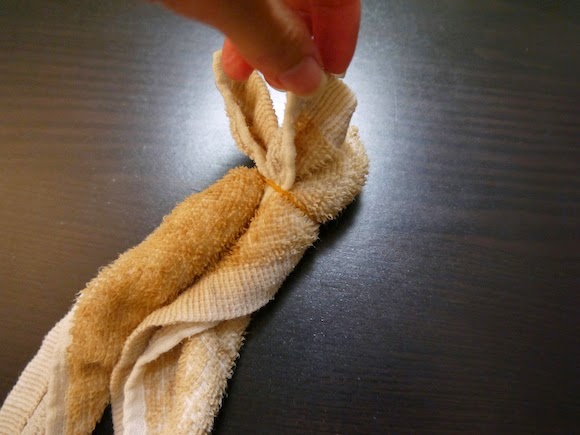
Just to make things a lot easier while finishing off the rest of the body, secure a rubber band around the rabbit’s neck (the part behind the ears). You can skip this part once you’ve gotten used to making towel bunnies, but for now, let’s use it. 
Kad zuikutis neprarastų formos, sutvirtinkite jo kūnelį gumyte (apsukite vietą už jo ausų). 


Slightly open the two rolls of towel that are sticking out. Cross the two open rolls over each other. These are your bunny’s legs! Fold the legs under the bunny’s body, making sure the front legs are nestled under his chin. Secure the bunny’s feet with the same rubber band that’s around his neck.
Šiek tiek praskirkite ir sukryžiuokite likusius rankšluosčio "rulonėlius", tada sulenkite juos, kad galai atsidurtų ties zuikučio snukučiu - tai bus zuikučio pėdutės. Sutvirtinkite pėdutes ta pačia gumute, kurią apvyniojote už jo ausų.


Fluff up the backside and you’ve got yourself an adorable towel bunny! 
Dabar tiesiog papurenkite zuikučio kūnelį, kad ygautų daugiau tūrio. Štai ir viskas - mielas minkštas zuikutis baigtas :) 


Source: http://youpouch.com/2014/02/04/167218/ http://en.rocketnews24.com

2015 m. kovo 21 d., šeštadienis

So unusual and intriguing works of Chinese artist Ah Xian. 
Artist explores aspects of the human form using ancient Chinese craft methods including porcelain, lacquer, jase, bronze, and even concrete. The artist often uses busts of his own family members including his wife, brother, and father onto which he imprints traditional designs with a vivid cobalt blue glaze.
More: http://www.art-days.com/ah-xian-porcelain-portraits/


2015 m. kovo 13 d., penktadienis


Magical stretchable paper Sculptures by Li Hongbo: Don’t trust your eyes – sometimes things are really not what they seem!

Artist glues thousands and thousands of paper in narrow strips and then shapes them with a band saw and an angle grinder into super detailed sculptures!


Read more: http://lostininternet.com/modern-chinese-art-movement-through-paper-sculptures/#ixzz3KjpU0RZn

2015 m. kovo 7 d., šeštadienis


Wonderfully illustrated stories in in three dimensional paper books by Japanese graphic designer and architect Yusuke Oono!!! 


 The 40-panel books are laser cut from paper and assembled into a booklet that can be viewed page by page or fanned out as a sort of layered diorama of silhouettes. 360°Book Sweet Home

360°Book Fujiyama http://www.loftwork.com/portfolios/oonoyusuke


360°Book Fujiyama http://www.loftwork.com/portfolios/oonoyusuke


360°Book Fujiyama http://www.loftwork.com/portfolios/oonoyusuke


http://www.loftwork.com/portfolios/oonoyusuke

360°Book Sweet Home http://www.loftwork.com/portfolios/oonoyusuke

 360°Book Sweet Home http://www.loftwork.com/portfolios/oonoyusuke

360°Book In a Cheese http://www.loftwork.com/portfolios/oonoyusuke


360°Book Christmas Version http://www.loftwork.com/portfolios/oonoyusuke


http://designmadeinjapan.com/magazine/laser-cut-3d-books-by-yusuke-ono/